AGL Cameroon Completes CFAF7.2 Billion Recapitalisation: What the Capital Restructuring Means
A CFAF7.215 billion capital increase at AGL Cameroon has now been completed, bringing the company's share capital back to CFAF10.621 billion.
At first glance, the figure looks like a sizeable injection into one of Cameroon's major logistics companies. But the structure of the transaction tells a more precise story.
AGL Cameroon did not end the process with CFAF7.2 billion more in share capital than it had before. The company first reduced its capital by the same amount and then rebuilt it through the issuance of new shares. The result is a restoration of the company's previous share capital rather than a net increase. (Business in Cameroon)
That distinction matters for anyone looking at the transaction from an investment, ownership or corporate-finance perspective.
What happened to AGL Cameroon's capital?
The operation was approved during an extraordinary general meeting held on March 6, 2026.
AGL Cameroon initially had share capital of CFAF10.621 billion, divided into 315,750 shares.
The company then reduced its capital by CFAF7.215 billion through the cancellation of 214,499 shares.
That brought the capital down to approximately CFAF3.406 billion.
The second stage reversed the reduction. AGL issued 214,499 new ordinary shares, each with a nominal value of CFAF33,639, for a total capital increase of CFAF7.215 billion.
The latest legal notice confirms that this second stage has now been completed. AGL Cameroon therefore returns to 315,750 shares and CFAF10.621 billion in share capital. (Business in Cameroon)
In simple terms:
Previous share capital: CFAF10.621 billion
Capital reduction: CFAF7.215 billion
Capital after reduction: CFAF3.406 billion
Subsequent capital increase: CFAF7.215 billion
Final share capital: CFAF10.621 billion
Final number of shares: 315,750
So, this is better understood as a capital restructuring and restoration, rather than a straightforward expansion of the company's equity base.
Why the transaction deserves attention
The legal notice confirms that the recapitalisation has been completed, but it leaves some important questions unanswered.
Most notably, the identities of the subscribers to the 214,499 new shares have not been disclosed in the notice, nor does it state how the new shares were distributed among shareholders. (Business in Cameroon)
That information could be important for understanding whether the restructuring changed the relative ownership positions within AGL Cameroon.
The question is particularly relevant because the company's shareholder structure has changed in recent years.
In September 2026, a separate legal notice confirmed that Cameroon Continental Merchants Limited (CCML) had acquired 31,575 AGL Cameroon shares, representing 10% of the company's 315,750 shares.
AGL's board approved the transfer in December 2024. The price paid for the stake was not disclosed. (Business in Cameroon)
The latest recapitalisation notice does not establish whether CCML retained exactly 10% following the capital reduction and subsequent share issuance.
That means the transaction provides a clear update on AGL's capital, but not a complete picture of its post-recapitalisation ownership structure.
AGL is operating in a changing logistics market
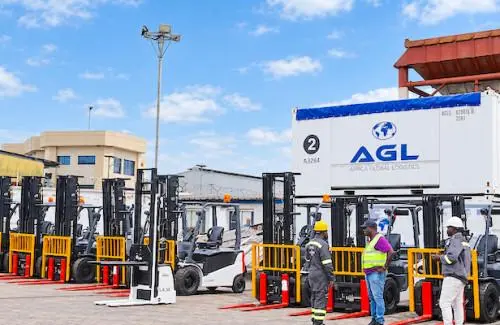
The capital restructuring comes at a time when AGL is expanding its footprint and investment in Cameroon's logistics sector.
AGL, formerly Bolloré Africa Logistics, became part of the MSC Group following MSC's acquisition of Bolloré Africa Logistics in December 2022. The business was subsequently rebranded Africa Global Logistics. Its operations span logistics, port terminals, maritime services and rail transport across Africa.
In Cameroon, the company is involved in several parts of the transport and logistics chain, giving its corporate structure significance beyond the balance sheet.
The company has also been increasing its investment in local operations.
For example, AGL committed CFAF2.6 billion to a new cocoa logistics platform at the Port of Kribi, according to reporting published in June 2026. A separate agreement involving AGL, the Cameroonian government and Camalco has also focused on the potential development of the Edéa–Kribi–Lolabé–Campo railway corridor. (Investir au Cameroun)
These developments point to a broader investment story around logistics infrastructure in Cameroon.
Logistics is becoming more strategic for Cameroon
The importance of logistics extends well beyond the companies operating in the sector.
Cameroon is positioning Kribi and Douala as complementary gateways for domestic and regional trade, while investment in roads, railways, ports and industrial zones is intended to improve the movement of goods.
The Port of Kribi, for example, has recorded increasing container and bulk traffic and is becoming more closely connected to agricultural and industrial supply chains.
For logistics companies, this creates opportunities in:
Freight forwarding
Warehousing
Port services
Road transport
Rail logistics
Customs-related services
Cold-chain logistics
Agricultural supply chains
Industrial cargo
Digital logistics platforms
But it also requires substantial capital.
Transport and logistics businesses need to finance vehicles, equipment, warehouses, technology, maintenance and human resources. Infrastructure projects can also take years before they generate their expected commercial returns.
That makes the structure and strength of a company's balance sheet an important part of the story.
Recapitalisation does not automatically mean fresh operating cash
This is where the AGL transaction requires some caution.
A capital increase is not necessarily the same thing as a company receiving CFAF7.2 billion in additional operating liquidity.
In AGL Cameroon's case, the latest transaction followed an equal capital reduction. The company's final share capital is therefore the same as before the restructuring. (Business in Cameroon)
Without additional information about the purpose of the reduction, the subscription arrangements and the use of the proceeds, it would be premature to interpret the transaction as evidence of a major new financing programme.
This distinction is important in corporate reporting.
Share capital, cash, assets, debt and working capital are different measures of a company's financial position.
A company can have a large share capital and still face liquidity pressures. Conversely, a capital restructuring can improve the corporate structure without immediately changing the amount of cash available for daily operations.
For investors and business observers, the next information to watch is therefore not simply AGL's registered capital, but its investment programme, financial performance and ownership structure.
The ownership question remains open
The arrival of CCML as a 10% shareholder earlier in the year adds another dimension.
The company acquired its 31,575 shares from AGL, with the transaction approved by AGL Cameroon's board in December 2024. The acquisition price was not made public. (Business in Cameroon)
The significance is not necessarily the identity of the investor alone. It is the fact that a major Cameroonian business interest now holds a direct stake in a large logistics operator at a time when the sector is undergoing infrastructure and supply-chain changes.
But the latest capital announcement does not provide enough information to determine how the recapitalisation affected each shareholder's percentage.
That will require additional corporate disclosures.
What businesses should watch next
For Cameroon’s logistics and investment community, several developments around AGL deserve attention.
1. The final shareholder structure
The identities and allocation of the new shares would provide a clearer picture of ownership following the restructuring.
2. Investment commitments
AGL's investments in logistics platforms and transport infrastructure could indicate where the company sees the strongest long-term demand.
3. Port and corridor development
Changes at Kribi, Douala and major road and rail corridors will affect the economics of logistics operators.
4. Agricultural exports
Cocoa and other agricultural commodities are creating demand for better storage, transport and export logistics.
5. Regional trade
As Cameroon seeks to strengthen its role as a gateway to CEMAC markets, logistics companies will be increasingly important to the movement of goods across borders.
Final Thoughts
AGL Cameroon's completion of its CFAF7.215 billion capital increase is significant, but the numbers need to be read carefully.
The operation restores the company's share capital to CFAF10.621 billion after an equal reduction. It does not, on the information currently disclosed, represent a net increase in registered share capital. (Business in Cameroon)
The more interesting questions now concern the ownership structure, the identity of the new share subscribers and how the company's capital position fits into its broader investment strategy.
Those questions come at an important moment for Cameroon's logistics industry. With ports, agricultural exports, industrial projects and transport corridors attracting greater investment, the companies moving goods around the country will have an increasingly important role in determining how efficiently that growth reaches the market.
For AGL Cameroon, the recapitalisation closes one chapter. The next one will be about what the company does with its strengthened corporate structure.