
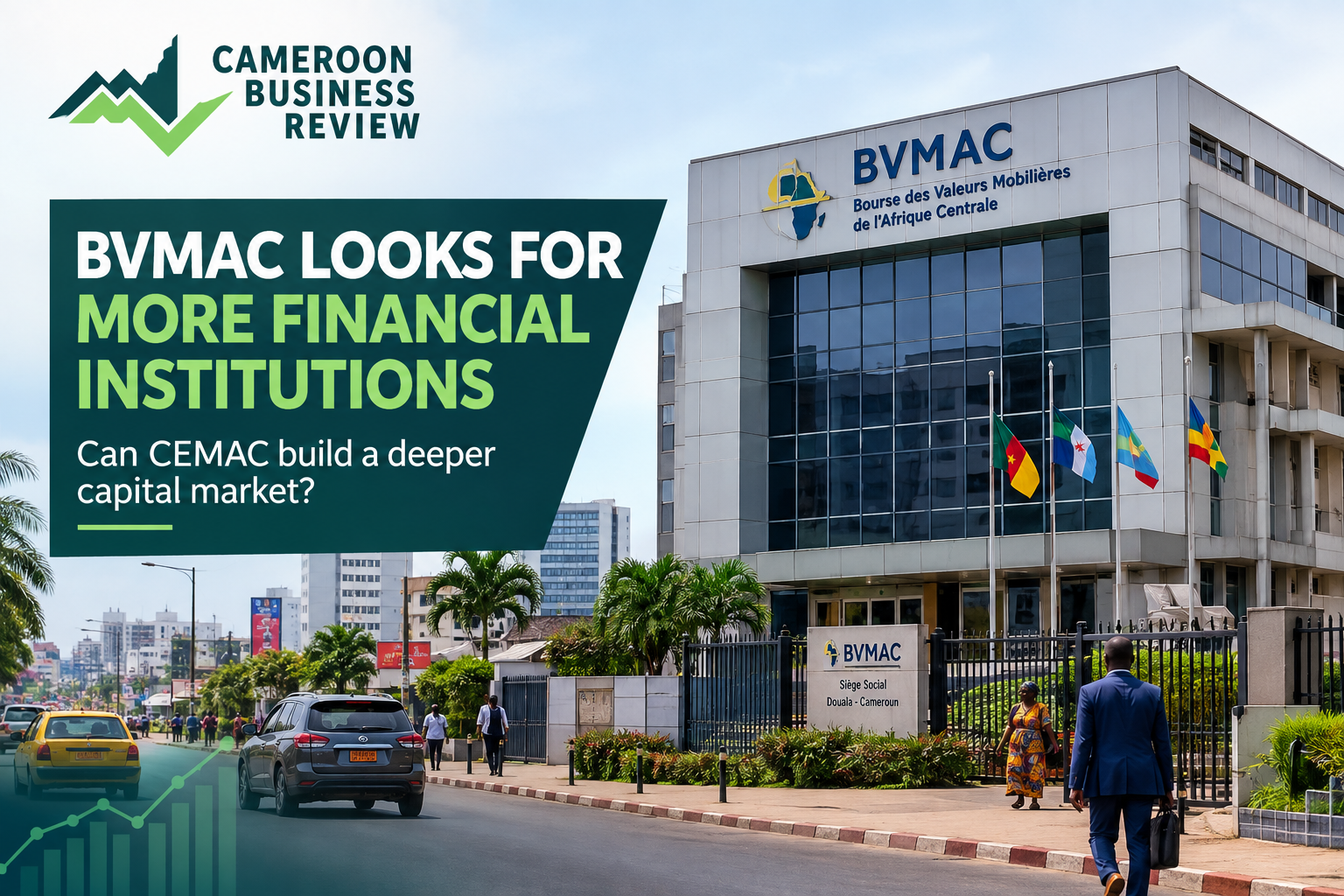
BVMAC Looks to Banks: Can Cameroon and CEMAC Build a Deeper Stock Market?
The Central African financial market is preparing for another push to bring financial institutions onto the stock exchange.
The Bourse des Valeurs Mobilières de l’Afrique Centrale (BVMAC) published new terms of reference in September for the preparation of a roadmap to support the listing of financial institutions across the six CEMAC countries. The initiative is being carried out under the Project to Support the Deepening of the Financial Sector in Central Africa (PASFIC), with financing from the African Development Fund through the African Development Bank. (bvm-ac.org)
For Cameroon, which hosts BVMAC's headquarters in Douala, the development is particularly relevant.
It comes at a time when the regional exchange is trying to expand beyond a relatively small group of listed companies and provide businesses with more alternatives to bank borrowing.
The immediate objective is not to announce a wave of IPOs. The first step is to identify institutions that could potentially list, assess their readiness, determine possible listing structures and establish a five-year programme for bringing suitable companies to the market. (Cameroon Tribune)
That makes the initiative less about one transaction and more about the architecture of the region's capital market.
Why financial institutions are now in focus
Banks, insurance companies and other financial institutions occupy a central position in the CEMAC economy.
They hold significant pools of capital, serve businesses across multiple sectors and already operate within formal financial and regulatory structures.
That makes them natural candidates for deeper capital-market participation.
According to the BVMAC process, the consultant selected for the assignment will prepare an inventory of potentially eligible financial institutions in Cameroon, Central African Republic, Congo, Gabon, Equatorial Guinea and Chad.
The assessment is expected to examine factors including the potential percentage of capital that could be offered to investors, theoretical market capitalisation, strengths and weaknesses of each institution and the possible method of listing. (Cameroon Tribune)
The two main approaches identified are the sale of existing shares by shareholders or the issuance of new shares through a capital increase.
That distinction matters.
A sale of existing shares can broaden ownership and provide liquidity to existing shareholders.
A new share issue can raise fresh capital for the company itself.
For a financial institution seeking to expand its balance sheet, invest in technology or strengthen its capital base, the second structure can be particularly relevant.
BVMAC has already shown what a major listing can do
The regional exchange has already had a major test case this year.
On May 7, 2026, BGFI Holding Corporation, the holding company of BGFIBank Group, was officially listed on BVMAC's A-PREMIUM segment.
The listing increased the number of companies quoted on the equity market from six to seven and lifted market capitalisation from CFAF479.4 billion to approximately CFAF1.71 trillion, according to BVMAC. The exchange said the transaction increased the circulating free float from CFAF70.2 billion to CFAF120.6 billion. (bvm-ac.org)
That single transaction demonstrates both the potential and the challenge facing the regional exchange.
A large financial institution can materially change the size of the market.
But it also shows how concentrated the equity market remains around a relatively small number of companies.
The new roadmap is therefore important because its success will depend on whether additional institutions can join the market without simply reproducing the same concentration.
The market needs more than listings
A bigger number of listed companies does not automatically create a deeper capital market.
Investors also need reasons to trade.
That requires companies with transparent financial reporting, credible governance, sufficient free float and a regular flow of information.
It also requires investors who understand listed securities and are willing to hold them over time.
This is one reason the new BVMAC initiative includes the promotion of financial and stock-market culture as part of the wider objective. Cameroon Tribune reported that the roadmap is intended to help increase financing through the financial market and expand stock-market transactions. (Cameroon Tribune)
In other words, the supply of securities and the demand for them have to develop together.
What this could mean for Cameroon
Cameroon is already the main operating environment for BVMAC, whose headquarters are in Douala.
A stronger equity market could give established Cameroonian businesses another avenue for raising capital.
For companies that have traditionally depended almost entirely on bank loans, an equity listing offers a different financing model.
Instead of borrowing the entire amount required for expansion, a company can potentially raise part of its capital from investors by selling shares.
The trade-off is greater disclosure, shareholder accountability and market scrutiny.
That can change how a company is managed.
For investors, meanwhile, more listed companies could create additional opportunities to participate in the growth of regional businesses.
The financing question behind Cameroon’s investment ambitions
The BVMAC initiative comes at an interesting point in Cameroon's economic development.
The government is pursuing large infrastructure, mining, energy, agricultural and industrial projects, while also seeking greater private-sector participation.
At the same time, the country has been engaging international investors about ways to finance projects through mechanisms including private capital, public-private partnerships, guarantees and blended finance.
The London investment roadshow in September was part of that broader effort. Cameroon presented investors with projects linked to the country's SND30 development strategy, which has an estimated investment envelope of more than CFAF87.8 trillion, with close to 45% expected from development partners and private capital. (Cameroon Tribune)
A functioning capital market can complement those efforts.
Not every project needs to be financed through the stock exchange. But a stronger domestic and regional capital market gives companies and investors another channel through which long-term capital can move.
The Renaprov Finance example
There is already movement beyond the BGFI Holding listing.
BVMAC published a decision in September concerning Renaprov Finance's application for a stock-market listing. The company had previously been admitted to the Central Depository of CEMAC in preparation for its arrival on the exchange. (bvm-ac.org)
The company's approved information document describes a planned CFAF8.4 billion capital increase through the issuance of 400,000 new shares at CFAF21,000 each. The operation is intended to involve both institutional and individual investors, subject to the applicable regulatory process. (bvm-ac.org)
This is important because it illustrates what a listing can mean beyond market visibility.
A new share issue can provide a company with additional capital while bringing new investors into its ownership structure.
The process also demonstrates the preparation required before a company reaches the exchange.
What companies will have to confront
For financial institutions considering a future listing, the process will involve more than meeting a technical requirement.
Companies will need to assess whether they are ready for the level of transparency expected of listed entities.
That includes reliable financial statements, corporate governance, shareholder structures, investor communication and the ability to provide regular market information.
Valuation will also matter.
A company may want to list at a particular valuation, while investors may assess the business differently.
The market therefore needs credible information on profitability, growth, risks and future capital requirements.
A five-year window
One of the most interesting elements of the new initiative is its five-year horizon.
The consultant is expected to conduct consultations with regulators and other stakeholders and develop a programme based on measurable results over five years. (Cameroon Tribune)
That suggests the authorities are looking beyond individual IPOs.
The objective is to create a pipeline.
Such a pipeline could allow institutions to prepare gradually rather than approaching the market only when they urgently need capital.
It also gives regulators, advisers, brokers and investors more time to develop the ecosystem required to support new listings.
What investors should watch
For investors following the CEMAC market, several developments will be worth monitoring.
First is the list of institutions eventually identified as potential candidates.
Second is how many of those institutions actually meet the requirements for listing.
Third is the structure of future transactions: whether companies sell existing shares, raise new capital or use a combination of approaches.
Fourth is the amount of free float made available to the public.
And finally, there is the question of liquidity.
A listed share is more useful to investors when there is a functioning secondary market in which buyers and sellers can transact.
That will remain one of the central tests for BVMAC as it expands.
Final Thoughts
BVMAC's new push to prepare financial institutions for stock-market listings comes at a time when Cameroon and the wider CEMAC region are looking for more ways to mobilise long-term private capital.
The initiative does not guarantee that a large number of banks or financial institutions will list. The immediate task is to identify potential candidates, assess their readiness and build a realistic five-year roadmap.
But the direction is clear: regional policymakers and market institutions are looking to make the capital market a more active part of how businesses raise money.
For Cameroon, the opportunity extends beyond BVMAC itself. A deeper equity market could give established companies another source of growth capital, give investors more choices and create a stronger connection between household and institutional savings and the businesses operating across the region.
The real measure of progress will ultimately be visible in the market: more credible issuers, more investable companies, more active trading and more capital reaching productive businesses.