
Cameroon and US Formalize CFAF 510 Billion Health Partnership Through 2030
Cameroon and the United States have moved their health partnership into a new implementation phase, with a framework that could mobilize about US$850 million, or roughly CFAF 510 billion, between 2026 and 2030.
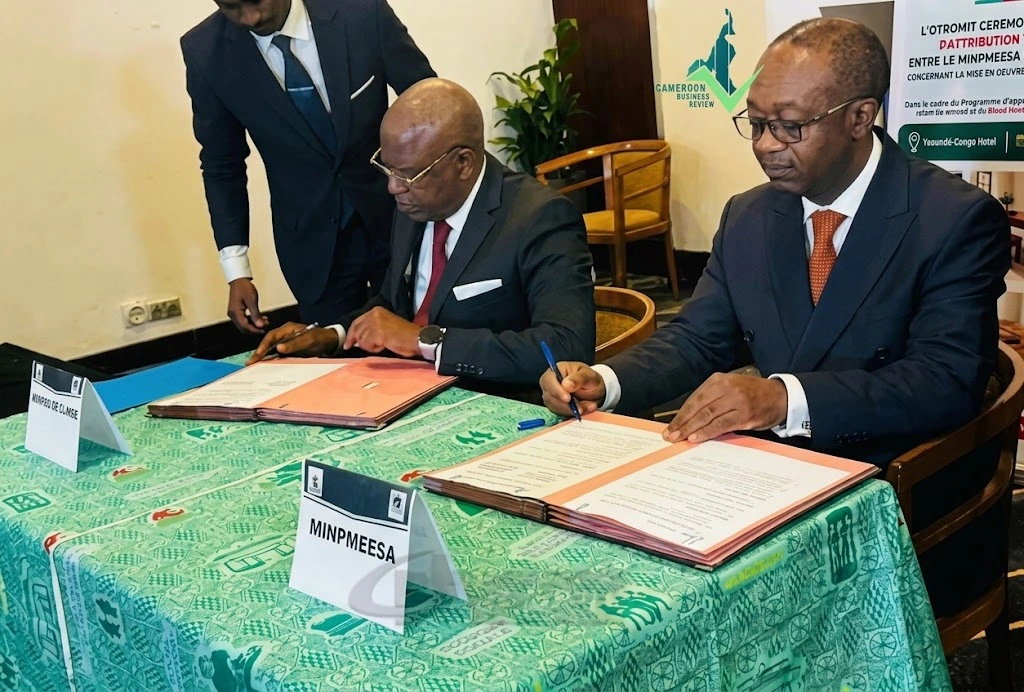
The Strategic Objective Grant Agreement (SOAG) was signed in Yaoundé on October 1 by Cameroon's Minister of Economy, Planning and Regional Development, Alamine Ousmane Mey, and Brenda Soya, the U.S. Embassy's chargé d'affaires ad interim. The signing was also attended by Health Minister Manaouda Malachie and other government officials.
The headline figure is substantial, but the structure of the financing is what makes the agreement particularly important.
The United States plans to provide about US$400 million (CFAF 240 billion), while Cameroon is expected to mobilize up to US$450 million (CFAF 270 billion) in additional resources for its health system.
That means the partnership is not structured as a conventional donor-funded programme. Cameroon is expected to put significant domestic resources behind the same health priorities.
How the CFAF 510 billion is structured
The financial framework is spread across the five-year period to 2030.
Contribution | Approximate amount |
|---|---|
U.S. support | US$400 million / CFAF 240 billion |
Cameroon co-investment | Up to US$450 million / CFAF 270 billion |
Potential combined resources | Up to US$850 million / CFAF 510 billion |
The figures were first outlined in a memorandum of understanding signed by Cameroon and the United States in December 2025. The October 2026 SOAG provides the financial framework for putting that partnership into operation.
It is therefore more accurate to view the CFAF 510 billion as the potential resource envelope under the partnership, rather than as money being transferred to Cameroon in one payment.
The U.S. contribution is about $400 million, while the Cameroon component is described as an additional commitment of up to $450 million.
What the money is intended to support
The agreement covers several areas of Cameroon's health system.
The priorities include:
HIV/AIDS, tuberculosis and malaria programmes
Disease surveillance and outbreak detection
Laboratory capacity
Health data and information systems
Pharmaceutical and medical-product supply chains
Maternal, newborn and child health
Performance of health districts
Health workforce strengthening
The "One Health" approach linking human, animal and environmental health
The U.S. side has also identified rapid outbreak detection and response, integrated digital health data and stronger supply chains among the expected results.
This gives the agreement a broader economic dimension.
It is not only about financing treatment or purchasing medicines. Some of the resources are intended to strengthen the systems that allow health services to function: laboratories, data, surveillance, logistics and human resources.
Cameroon is being asked to put more money into its own health system
The biggest change in the structure of the partnership is the size of the planned Cameroon contribution.
The government is expected to mobilize up to CFAF 270 billion over five years in addition to the U.S. contribution.
MINEPAT describes this as a co-investment approach aimed at gradually strengthening Cameroon's ability to finance and manage its health system itself.
That matters because external funding can support a health programme, but it cannot by itself guarantee that the system will remain financially sustainable once a programme ends.
The new arrangement puts more emphasis on government financing and country ownership.
It also creates a clear test for public spending: whether the additional domestic resources produce measurable improvements in services rather than simply increasing the size of health budgets.
A partnership built on two decades of U.S. health support
The new agreement builds on a long history of American health assistance in Cameroon.
According to MINEPAT, the United States has invested more than US$1.1 billion, equivalent to about CFAF 640 billion, in Cameroon's health sector over the past two decades.
Earlier U.S. programmes in Cameroon have included support for HIV/AIDS, malaria, tuberculosis, disease surveillance, laboratories and emergency response.
U.S. government documents have also identified the importance of increasing Cameroon's domestic financing and ownership of health programmes supported by American funding.
The new agreement therefore represents a change in financing structure rather than the beginning of U.S.-Cameroon health cooperation.
Why health financing matters to the economy
Health spending is often treated as a social-sector issue, but its effects extend into the wider economy.
A worker who spends less time sick can remain productive. A reliable pharmaceutical supply chain reduces interruptions in treatment. Stronger laboratories can help identify outbreaks earlier. Better health data can improve how governments allocate resources.
The relationship also works in the other direction.
Weak health systems can create costs for employers, households and government. Disease outbreaks can interrupt economic activity, while shortages of essential medicines can increase household spending and place additional pressure on public finances.
Cameroon's new health partnership therefore has implications beyond hospitals and clinics.
The World Bank and other development institutions have long linked stronger human capital, including health, with productivity and economic development.
The U.S. government has similarly identified health-system strengthening in Cameroon as part of efforts to maintain a healthy workforce and improve the country's capacity to prevent and respond to public-health threats.
Supply chains could become a major business issue
One area worth watching is the pharmaceutical and medical supply chain.
The agreement specifically includes efforts to improve the availability and management of health products.
For businesses, this is important because healthcare supply chains involve more than hospitals.
They include manufacturers, importers, wholesalers, distributors, logistics companies, pharmacies, laboratories and technology providers.
Improving the system could create opportunities for companies involved in logistics, digital health, laboratory services and local production of medical products.
It could also reduce some of the operational weaknesses that arise when essential products are unavailable or distribution systems are fragmented.
Cameroon's national digital health strategy for 2026–2030 already places emphasis on health information systems, digital health infrastructure and local innovation.
The combination of that strategy with the new U.S.-Cameroon health framework could make digital health and health-data infrastructure areas to watch over the next several years.
The workforce is another test
Funding infrastructure without enough trained people to operate it would limit the impact of the investment.
The new programme therefore also puts attention on the health workforce and the performance of health districts. The U.S. side has identified a sustainable health workforce as one of the intended outcomes.
For Cameroon, that raises questions about training, recruitment, retention and deployment.
A laboratory in Yaoundé does not solve a surveillance problem if district-level systems cannot collect and transmit reliable information.
Likewise, digital health systems have limited value if health workers do not have the skills, equipment and connectivity to use them.
The success of the programme will therefore depend partly on how well national and local institutions are connected to the investment.
From donor support to shared financing
There is also a broader policy shift behind the numbers.
For much of the past two decades, U.S. health programmes in Cameroon have relied heavily on external financing. The new arrangement asks the Cameroonian government to increase its own contribution while the United States continues to provide substantial support.
That model puts sustainability at the centre of the partnership.
It also means Cameroon will have a larger financial stake in whether the programmes succeed.
The government's ability to actually mobilize the planned CFAF 270 billion will therefore be important to watch over the five-year period.
So will the way those resources are integrated into national health budgets and systems.
What businesses should watch
For companies operating in Cameroon, the health partnership could have effects across several parts of the economy.
The areas most directly connected to the programme include:
Healthcare delivery: Investment in health districts and services could increase demand for equipment, professional services and infrastructure.
Pharmaceutical supply chains: Better procurement, warehousing and distribution systems could affect manufacturers, importers and logistics providers.
Digital health: Health information systems and integrated data platforms could create opportunities for technology companies and local developers.
Workforce development: Training and retention of health professionals could support a stronger healthcare labour market.
Local manufacturing: A stronger health-product supply chain could create incentives for greater local production over time.
None of these outcomes is automatic. They will depend on how the programme is implemented and how procurement, financing and institutional responsibilities are structured.
The next five years will matter more than the headline figure
The CFAF 510 billion figure makes for a large headline, but the value of the agreement will ultimately be measured through outcomes.
The government and its U.S. partners have already identified areas such as outbreak response, health-product availability, workforce development and integrated health data as priorities.
The next step is implementation.
That means translating a five-year financial framework into budgets, programmes, procurement, infrastructure, training and measurable improvements at the district level.
For Cameroon, the biggest question is not simply how much money is attached to the partnership.
It is whether the investment leaves behind stronger systems that can continue functioning when external support declines.
Final Thoughts
Cameroon and the United States have formalized a health partnership that could mobilize up to CFAF 510 billion through 2030.
The United States is expected to provide about CFAF 240 billion, while Cameroon plans to mobilize up to CFAF 270 billion of its own resources.
That co-investment structure makes the agreement different from a straightforward aid programme.
For the health sector, the priorities include disease control, laboratories, surveillance, medicines, data systems and health workers. For the wider economy, the potential benefits lie in a healthier workforce, stronger supply chains and better capacity to manage health shocks.
The numbers are significant.
But the more important story will be what those resources build between now and 2030.
Cameroon Business Review will be watching the implementation, financing and business opportunities that emerge as the partnership moves from agreement to execution.