
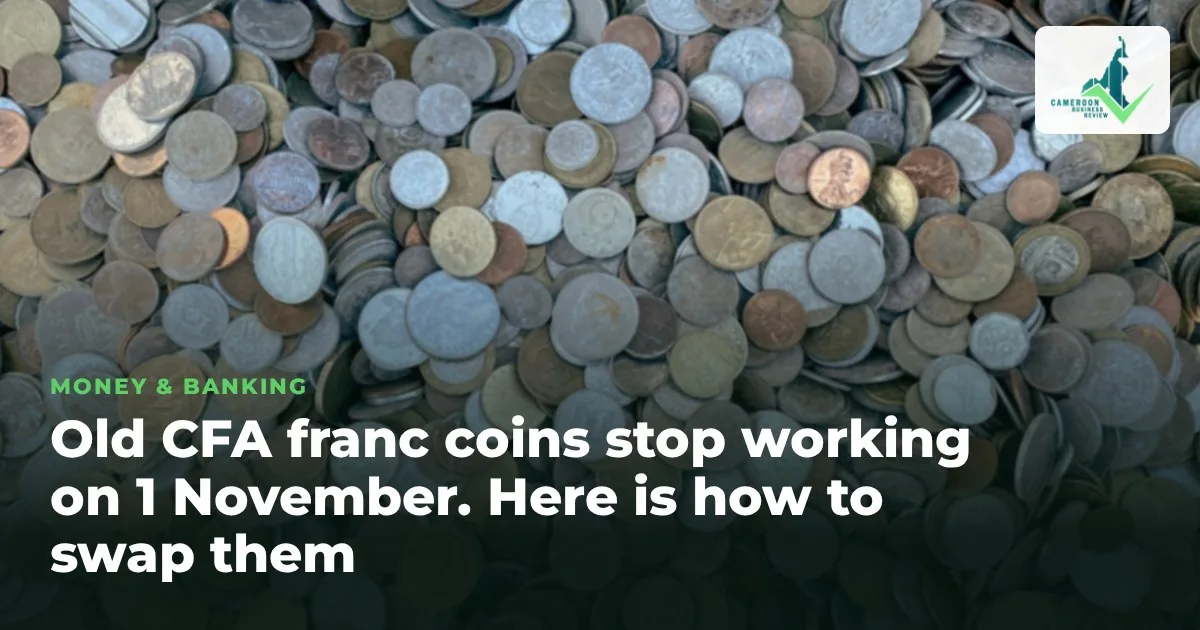
Old CFA franc coins will stop being accepted in payments across Cameroon and the rest of the CEMAC zone on 1 November 2026, less than two weeks from now. The Bank of Central African States (BEAC) is withdrawing five older coin series and giving holders a year to swap them for free, according to a BEAC information note reported by Investir au Cameroun.
For traders, transport operators, petrol stations and any business that handles a lot of small change, the change means sorting the cash drawer now. After the exchange window closes, the old coins will be worth only their metal.
Which old CFA franc coins are affected
The withdrawal covers coins from five series issued between 1958 and 1985:
- the 1958 series
- the 1959 series
- the 1971 series
- the 1976 series
- the 1985 series
Coins from the 2006 series and the 2024 series remain legal tender. The year of issue is stamped on each coin, so the quickest check is to look at the date.
The decision applies in all six CEMAC countries: Cameroon, Congo, Gabon, Equatorial Guinea, Chad and the Central African Republic.
Key dates for the exchange
BEAC has set out a two-stage timetable:
- Until 31 October 2026: the old coins can still be used in transactions.
- 1 November 2026 to 31 July 2027 (nine months): the old coins can no longer be spent, but they can be exchanged free of charge at commercial banks, microfinance institutions and BEAC counters.
- 1 August to 31 October 2027 (three months): exchange only at BEAC counters.
- From 1 November 2027: no exchange at all.
BEAC Governor Yvon Sana Bangui was blunt about the cut-off. After 31 October 2027, he said, the demonetised coins "cesseront définitivement d'être échangées, quels que soient les guichets" (will no longer be exchanged at any counter).
How the decision was taken
The BEAC board proposed the withdrawal at a meeting on 5 October 2026. The UMAC Ministerial Committee, which brings together the region's finance ministers, approved it in N'Djamena, Chad, on 7 October. The governor published the information note on 9 October.
Why BEAC is pulling the coins
The central bank gives two reasons.
The first is housekeeping. BEAC wants a simpler range of coins in circulation now that the 2024 series is widely used, and says many of the older coins are worn.
The second is a long-running shortage of small change. BEAC has linked coin scarcity in the region to networks that gather coins and export them to Asia, where the metal is worth more than the face value and is used, among other things, in jewellery. Former governor Abbas Mahamat Tolli first raised the problem in December 2019. Sana Bangui said after a Monetary Policy Committee meeting in Malabo on 24 March 2025 that the bank had changed the metal mix of the new coins to remove that incentive. BEAC has never published how many coins left the region this way or what they were worth.
The 2024 coin series
The replacement coins were launched in Bangui on 2 April 2025. The 2024 series has nine denominations:
- 1, 2, 5, 10 and 25 FCFA
- 50 and 100 FCFA, both with a faceted edge to make them easier to recognise and harder to fake
- 200 FCFA, a new denomination
- 500 FCFA
BEAC plans to issue 500 million coins a year, with a target of 3 billion in circulation by 2030.
What Cameroonian businesses should do now
- Sort your cash. Separate pre-2006 coins from 2006 and 2024 coins before 1 November.
- Brief staff. Cashiers should refuse old coins from 1 November, since the business will then carry the cost of exchanging them.
- Bank early. Banks and microfinance institutions accept old coins only until 31 July 2027. After that, the only option is a BEAC branch, which for many businesses outside Yaoundé and Douala means a longer trip.
- Use digital payments for small amounts. The coin shortage is one reason mobile money has spread so fast for small purchases. Orange Money and MTN MoMo are now big enough that they earned CFA21.5 billion in interest on users' funds in 2025.
What is still unclear
BEAC has not said how many old coins are still in circulation, nor whether it expects the withdrawal to make small change scarcer in the short term. Shopkeepers in Cameroon have long rounded prices or handed out sweets instead of change. If the new coins do not reach markets quickly, that habit may return for a while after 1 November.