Cameroon’s IsDB Business Forum Opens New Financing Channels for the Private Sector
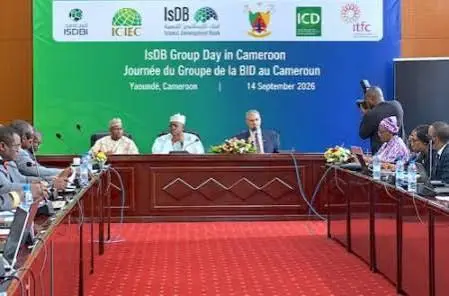
Cameroon brought government, investors, banks, development institutions and business leaders together in Yaoundé on September 14 for the inaugural Islamic Development Bank (IsDB) Group Day, placing private-sector financing and investment partnerships at the centre of discussions about the country's next phase of economic development.
More than 500 participants attended the forum, which combined policy discussions with business-to-business and business-to-government meetings. The event also resulted in financing agreements and letters of intent valued at €137 million, while Cameroon and the IsDB Group began preparations for a new Country Engagement Framework covering 2027–2029. (MENAFN)
For businesses, however, the significance of the forum goes beyond the headline financing figure. The bigger question is whether the different instruments presented by the IsDB Group can translate into accessible capital for companies, stronger trade flows and investment in productive sectors.
From development financing to business opportunities
Cameroon's relationship with the IsDB Group is not new. The country joined the institution in 1977, and the IsDB Group says it has approved approximately US$4.2 billion for projects benefiting Cameroon since then. (MENAFN)
What is changing is the increasing attention being given to the private sector.
The September forum brought together representatives from:
Government institutions
Banks and financial institutions
Private companies
Chambers of commerce
Investors
Development partners
International organisations
The IsDB Group presented financing and support mechanisms covering investment, trade finance, investment insurance, Islamic finance and capacity building.
This matters because access to finance remains one of the constraints facing many Cameroonian businesses, particularly SMEs seeking medium- and long-term capital.
The forum therefore created a space where businesses could engage directly with institutions within the wider IsDB Group, including the Islamic Corporation for the Development of the Private Sector (ICD), the International Islamic Trade Finance Corporation (ITFC), the Islamic Corporation for the Insurance of Investment and Export Credit (ICIEC) and the IsDB Institute. (MENAFN)
CFAF89 billion in agreements and letters of intent
The €137 million announced at the forum is equivalent to roughly CFAF89 billion, based on the CFA franc's fixed euro parity.
The figure covers several financing agreements between the IsDB and Cameroon as well as letters of intent involving the private-sector arm of the group and financial partners. That distinction is important.
A financing agreement represents a more concrete commitment than a preliminary expression of interest, while a letter of intent can still require further structuring and conditions before financing becomes available.
This is particularly relevant because earlier reports had placed the value of documents expected around the event at about €385.85 million, or CFAF253.1 billion. That larger figure included potential financing agreements and letters of intent whose final composition was not initially clear. The amount ultimately reported by the IsDB Group after the event was €137 million. (Business in Cameroon)
For companies and investors following the developments, the individual agreements, beneficiaries, financing terms and disbursement schedules will therefore be more informative than the headline total alone.
SMEs are becoming a central part of the conversation
One of the most commercially relevant themes from the forum was SME financing.
The IsDB Group has already been expanding its engagement with Cameroonian financial institutions.
In June 2026, the Islamic Corporation for the Development of the Private Sector signed a €20 million Sharia-compliant line of financing term sheet with AFG Bank Cameroon. The facility is intended to support SMEs in Cameroon, Gabon and Chad, particularly in sectors including agribusiness, transport, energy and healthcare. The project is expected to support more than 2,200 jobs across partner and beneficiary levels. (ICD-PS)
During the September forum, Afriland First Bank also signed a letter of intent with ICD for a proposed €50 million, approximately CFAF32.8 billion, financing facility targeting SMEs and eligible private-sector projects in Cameroon.
The proposed facility covers areas including agriculture, agro-industry, healthcare, manufacturing and transport, while also supporting the bank's Islamic finance activities. (Business in Cameroon)
Together, these developments point toward an important issue for Cameroon’s business community: the availability of financing is increasingly being linked to the ability of companies and financial intermediaries to structure projects that meet lenders' requirements.
Agriculture and rural investment remain major priorities
The IsDB's engagement is also extending beyond urban businesses and financial institutions.
One of the agreements signed during the Group Day concerns the Dja Integrated Rural Development Project, covering Cameroon's East and South regions.
The project has financing of approximately €41.92 million, or CFAF27.5 billion, and targets agricultural development and rural infrastructure. It is expected to benefit around 250,000 people directly, with interventions covering agricultural production, rural roads, water, education and health infrastructure. (Business in Cameroon)
IsDB information also indicates that the project is expected to support climate-smart agro-pastoral value chains, training for 5,000 value-chain actors and the creation of 50,000 jobs, with an emphasis on women and young people. (TwStalker)
For businesses, the significance lies in the value-chain approach.
Agricultural financing can create opportunities beyond primary production, including:
Processing and packaging
Agricultural logistics
Cold-chain services
Equipment supply
Storage and warehousing
Digital agricultural services
Input distribution
Rural financial services
This is particularly relevant as Cameroon seeks to increase the amount of value retained domestically from its agricultural commodities.
Infrastructure remains part of the financing pipeline
Infrastructure is another major area of cooperation.
Among the projects associated with the IsDB pipeline is the rehabilitation of the 218.9-kilometre Douala–Bafoussam road. The IsDB has approved a contribution of about €212.35 million, or CFAF139.3 billion, representing more than 92% of the estimated project cost. (Business in Cameroon)
The road is strategically important for the movement of people and goods between the country's economic capital and the western part of Cameroon.
But it also illustrates why financing announcements need to be separated from actual implementation. Approval of financing does not automatically mean that funds have been disbursed or that construction has begun. Procurement, contractual arrangements and other conditions still determine when a project moves from financing approval to physical execution. (Business in Cameroon)
For companies, that distinction matters because infrastructure projects create business opportunities at different stages — from engineering and construction to logistics, materials, professional services and local supply chains.
A new 2027–2029 framework is now being prepared
Perhaps the longer-term development from the forum is the preparation of a new Country Engagement Framework (CEF) for Cameroon covering 2027–2029.
The framework is expected to align IsDB Group support with Cameroon's National Development Strategy 2030 (SND30) and the bank's own strategic priorities. (MENAFN)
Discussions have focused on several areas:
Public-private partnerships
Renewable energy and green infrastructure
Human capital
SME financing
Trade integration
Investment
Youth and women's entrepreneurship
Private-sector participation in national development
Earlier discussions between Cameroon and the IsDB Group had already identified infrastructure, energy, agriculture, education and health among areas for cooperation. (Cameroon Tribune)
The framework could therefore become important for businesses looking beyond individual financing deals toward a more predictable pipeline of investment opportunities.
Islamic finance is gaining space in Cameroon
Another development worth watching is the gradual expansion of Islamic finance within Cameroon's financial system.
Islamic finance generally uses structures based on asset-backed transactions, profit-sharing or trade-related financing rather than conventional interest-based lending. For companies, the relevance is less about the terminology and more about whether these instruments can provide additional sources of capital.
The growing involvement of institutions such as ICD and ITFC, alongside Islamic finance windows within local banks, gives businesses another channel through which to explore financing.
It also creates opportunities for financial institutions, advisory firms, legal professionals and companies capable of structuring projects that meet the requirements of these instruments.
The next test is execution
The IsDB Group Day gave Cameroon an important platform to connect capital with businesses and development priorities.
But the business community will ultimately judge the impact through implementation.
For the private sector, the questions are practical:
How quickly will approved financing reach projects?
Which SMEs will qualify for the new credit facilities?
What financing conditions will businesses face?
Which sectors will receive the largest share of investment?
How much local procurement will projects generate?
Will financing reach businesses outside the largest urban centres?
How will public and private capital be combined for larger projects?
These questions will become increasingly important as Cameroon seeks to mobilise more private investment alongside public and development financing.
The forum's B2B and B2G meetings are particularly relevant because they provide a bridge between broad development priorities and individual commercial projects. (MENAFN)
Final Thoughts
The IsDB Group Day in Cameroon marks a broader shift in the country's investment conversation: development financing is increasingly being discussed alongside private-sector growth, SME finance, trade and investment partnerships.
The €137 million in agreements and letters of intent provides a concrete starting point, while the preparation of the 2027–2029 Country Engagement Framework gives the relationship a longer-term horizon. (MENAFN)
For Cameroon’s businesses, the opportunity will depend on what happens after the forum — which projects become financeable, which companies gain access to capital and how quickly signed agreements translate into investment on the ground.
That is where the next chapter of the Cameroon–IsDB partnership will be measured.